QUESTION 197
You are an ISMS audit team leader tasked with conducting a follow-up audit at a client’s data centre. Following two days on-site you conclude that of the original 12 minor and 1 major nonconformities that prompted the follow-up audit, only 1 minor nonconformity still remains outstanding.
Select four options for the actions you could take.
According to ISO 19011:2018, which provides guidelines for auditing management systems, clause 6.7 requires the audit team leader to conduct a follow-up audit to verify the implementation and effectiveness of the corrective actions taken by the auditee in response to the nonconformities identified during a previous audit1. The follow-up audit should be conducted in accordance with the same principles and processes as the initial audit, and should result in a conclusion on the status of the nonconformities and any remaining issues1. Therefore, when conducting a follow-up audit, an ISMS auditor should consider the following actions:
Recommend that the outstanding minor nonconformity is dealt with at the next surveillance audit: This action is appropriate because it reflects the fact that the auditee has cleared most of the nonconformities, including the major one, and only one minor nonconformity remains outstanding. A minor nonconformity is defined as a failure to achieve one or more requirements of ISO/IEC 27001:2022 or a situation which raises significant doubt about the ability of an ISMS process to achieve its intended output, but does not affect its overall effectiveness or conformity2. Therefore, this finding does not prevent or preclude the continuation of certification, as long as it is addressed by appropriate corrective actions within a reasonable time frame. The auditor should recommend that the outstanding minor nonconformity is dealt with at the next surveillance audit, which is a regular audit conducted by the certification body to confirm the ongoing conformity and effectiveness of an ISMS3.
Agree with the auditee/audit client how the remaining nonconformity will be cleared, by when, and how its clearance will be verified: This action is appropriate because it reflects the fact that the auditee has demonstrated commitment and capability to implement corrective actions for the nonconformities identified during the previous audit. The auditor should agree with the auditee/audit client on a realistic, achievable, and effective corrective action plan for the remaining nonconformity, including a clear deadline and verification method. The auditor should also document this agreement in the follow-up audit report1.
Advise the individual managing the audit programme of any decision taken regarding the outstanding nonconformity: This action is appropriate because it reflects the fact that the auditor has followed a systematic and consistent approach to conducting and reporting the follow-up audit. The auditor should advise the individual managing the audit programme of any decision taken regarding the outstanding nonconformity, such as recommending its closure at the next surveillance audit or agreeing on a corrective action plan with the auditee/audit client. The auditor should also provide sufficient information and evidence to support their decision1.
Close the follow-up audit as the organisation has demonstrated it is committed to clearing the nonconformities raised: This action is appropriate because it reflects the fact that the organisation has achieved satisfactory results in the follow-up audit. The auditor should close the follow-up audit as the organisation has demonstrated it is committed to clearing the nonconformities raised by implementing effective corrective actions for most of them and agreeing on a plan for the remaining one. The auditor should also communicate the follow-up audit conclusion to the auditee/audit client and other relevant parties1.
QUESTION 201
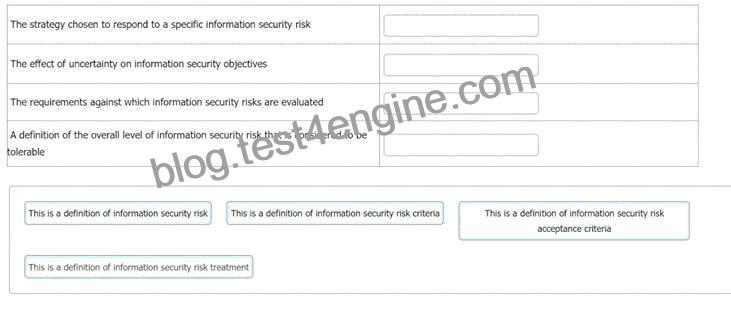
You have just completed a scheduled information security audit of your organisation when the IT Manager approaches you and asks for your assistance in the revision of the company’s risk management process.
He is attempting to update the current documentation to make it easier for other managers to understand, however, it is clear from your discussion he is confusing several key terms.
You ask him to match each of the descriptions with the appropriate risk term. What should the correct answers be?
Explanation:
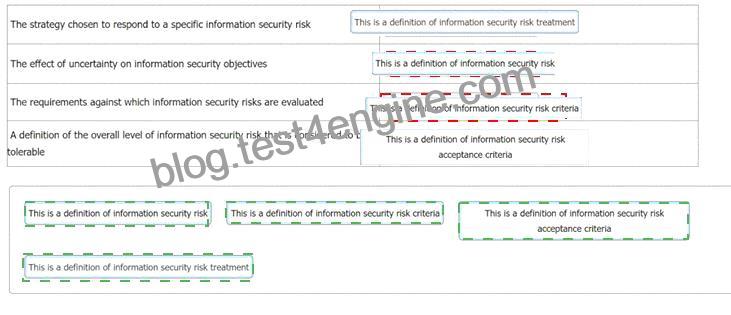
The correct answers for matching each of the descriptions with the appropriate risk term are:
* The strategy chosen to respond to a specific information security risk: This is a definition of information
* security risk treatment. According to ISO/IEC 27000:2022, information security risk treatment is “the process of selecting and implementing measures to modify the information security risk” Section 3.33.
* The effect of uncertainty on information security objectives: This is a definition of information security risk. According to ISO/IEC 27000:2022, information security risk is “the effect of uncertainty on information security objectives” Section 3.32.
* The requirements against which information security risks are evaluated: This is a definition of information security risk criteria. According to ISO/IEC 27000:2022, information security risk criteria are “the terms of reference by which the significance of information security risks is assessed” Section
3.31.
* A definition of the overall level of information security risk that is considered to be tolerable: This is a definition of information security risk acceptance criteria. According to ISO/IEC 27000:2022, information security risk acceptance criteria are “the level of information security risk that is acceptable” Section 3.30.
QUESTION 203
You are conducting an Information Security Management System audit in the despatch department of an international logistics organisation that provides shipping services to large organisations including local hospitals and government offices.
Parcels typically contain pharmaceutical products, biological samples and documents such as passports and driving licences.
You note that the company records show a very large number of returned items with causes including misaddressed labels and, in 15% of cases, two or more labels for different addresses for the one package. You are interviewing the Shipping Manager (SM).
You: Are items checked before being dispatched?
SM: Any obviously damaged items are removed by the duty staff before being dispatched, but the small profit margin makes it uneconomic to implement a formal checking process.
You: What action is taken when items are returned?
SM: Most of these contracts are relatively low value, therefore it has been decided that it is easier and more convenient to simply reprint the label and re-send individual parcels than it is to implement an investigation.
You raise a non-conformity against clause 8.1 of ISO 27001:2022.
Which one option below that best describes the non-conformity you have identified?
The non-conformity you have identified relates to the organization’s failure to implement adequate operational controls to ensure that service and regulatory requirements for data protection are met. This situation is particularly critical given the nature of the items being shipped, which include sensitive medical information and government documents. The fact that 15% of returned parcels have labels for different addresses, potentially exposing sensitive information to incorrect recipients, underscores the lack of effective information security practices.
The best description of the non-conformity, based on the details provided and the requirements of ISO/IEC 27001:2022, particularly clause 8.1 which deals with operational planning and control, would be:
C . The organisation does not have an effective process in place that ensures service requirements and regulatory requirements for data protection are met. Records show that 15% of returned parcels have disclosed information intended for another party to the recipient (which may include sensitive medical information or government department communications) without adequate operational controls to meet information security requirements.
This option accurately captures the essence of the non-conformity by highlighting the lack of effective operational controls to protect sensitive information, leading to potential unauthorized disclosure of information intended for another party. This is a direct violation of information security management principles, particularly those related to the protection of confidentiality and integrity of information as mandated by ISO/IEC 27001:2022.
QUESTION 204
Scenario 8: EsBank provides banking and financial solutions to the Estonian banking sector since September 2010. The company has a network of 30 branches with over 100 ATMs across the country.
Operating in a highly regulated industry, EsBank must comply with many laws and regulations regarding the security and privacy of dat a. They need to manage information security across their operations by implementing technical and nontechnical controls. EsBank decided to implement an ISMS based on ISO/IEC 27001 because it provided better security, more risk control, and compliance with key requirements of laws and regulations.
Nine months after the successful implementation of the ISMS, EsBank decided to pursue certification of their ISMS by an independent certification body against ISO/IEC 27001 .The certification audit included all of EsBank’s systems, processes, and technologies.
The stage 1 and stage 2 audits were conducted jointly and several nonconformities were detected. The first nonconformity was related to EsBank’s labeling of information. The company had an information classification scheme but there was no information labeling procedure. As a result, documents requiring the same level of protection would be labeled differently (sometimes as confidential, other times sensitive).
Considering that all the documents were also stored electronically, the nonconformity also impacted media handling. The audit team used sampling and concluded that 50 of 200 removable media stored sensitive information mistakenly classified as confidential. According to the information classification scheme, confidential information is allowed to be stored in removable media, whereas storing sensitive information is strictly prohibited. This marked the other nonconformity.
They drafted the nonconformity report and discussed the audit conclusions with EsBank’s representatives, who agreed to submit an action plan for the detected nonconformities within two months.
EsBank accepted the audit team leader’s proposed solution. They resolved the nonconformities by drafting a procedure for information labeling based on the classification scheme for both physical and electronic formats. The removable media procedure was also updated based on this procedure.
Two weeks after the audit completion, EsBank submitted a general action plan. There, they addressed the detected nonconformities and the corrective actions taken, but did not include any details on systems, controls, or operations impacted. The audit team evaluated the action plan and concluded that it would resolve the nonconformities. Yet, EsBank received an unfavorable recommendation for certification.
Based on the scenario above, answer the following question:
Which option justifies the unfavorable recommendation for certification? Refer to scenario 8.
QUESTION 205
You are an experienced ISMS audit team leader providing guidance to an ISMS auditor in training. They have been asked to carry out an assessment of external providers and have prepared a checklist containing the following activities. They have asked you to review their checklist to confirm that the actions they are proposing are appropriate.
The audit they have been invited to participate in is a third-party surveillance audit of a data centre . The data centre agent is part of a wider telecommunication group. Each data centre within the group operates its own ISMS and holds its own certificate.
Select three options that relate to ISO/IEC 27001:2022’s requirements regarding external providers.
* A. I will check the other data centres are treated as external providers, even though they are part of the same telecommunication group. This is appropriate because clause 8.1.4 of ISO 27001:2022 requires the organisation to ensure that externally provided processes, products or services that are relevant to the information security management system are controlled. Externally provided processes, products or services are those that are provided by any external party, regardless of the degree of its relationship with the organisation. Therefore, the other data centres within the same telecommunication group should be treated as external providers and subject to the same controls as any other external provider12
* B. I will ensure external providers have a documented process in place to notify the organisation of any risks arising from the use of its products or services. This is appropriate because clause 8.1.4 of ISO
27001:2022 requires the organisation to implement appropriate contractual requirements related to information security with external providers. One of the contractual requirements could be the obligation of the external provider to notify the organisation of any risks arising from the use of its products or services, such as security incidents, vulnerabilities, or changes that could affect the information security of the organisation. The external provider should have a documented process in place to ensure that such notification is timely, accurate, and complete12
* E. I will ensure the organisation is regularly monitoring, reviewing and evaluating external provider performance. This is appropriate because clause 8.1.4 of ISO 27001:2022 requires the organisation to monitor, review and evaluate the performance and effectiveness of the externally provided processes, products or services. The organisation should have a process in place to measure and verify the conformity and suitability of the external provider’s deliverables and activities, and to provide feedback and improvement actions as necessary. The organisation should also maintain records of the monitoring, review and evaluation results12
* F. I will ensure the organisation has determined the need to communicate with external providers regarding the ISMS. This is appropriate because clause 7.4.2 of ISO 27001:2022 requires the organisation to determine the need for internal and external communications relevant to the information security management system, including the communication with external providers. The organisation should define the purpose, content, frequency, methods, and responsibilities for such communication,
* and ensure that it is consistent with the information security policy and objectives. The organisation should also retain documented information of the communication as evidence of its implementation12 The following activities are not appropriate for the assessment of external providers according to ISO
27001:2022:
* C. I will ensure that the organisation has a reserve external provider for each process it has identified as critical to preservation of the confidentiality, integrity and accessibility of its information. This is not appropriate because ISO 27001:2022 does not require the organisation to have a reserve external provider for each critical process. The organisation may choose to have a contingency plan or a backup solution in case of failure or disruption of the external provider, but this is not a mandatory requirement. The organisation should assess the risks and opportunities associated with the external provider and determine the appropriate treatment options, which may or may not include having a reserve external provider12
* D. I will limit my audit activity to externally provided processes as there is no need to audit externally provided products or services. This is not appropriate because clause 8.1.4 of ISO 27001:2022 requires the organisation to control the externally provided processes, products or services that are relevant to the information security management system. Externally provided products or services may include software, hardware, data, or cloud services that could affect the information security of the organisation. Therefore, the audit activity should cover both externally provided processes and products or services, as applicable12
* G. I will ensure that top management have assigned roles and responsibilities for those providing external ISMS processes as well as internal ISMS processes. This is not appropriate because clause 5.3 of ISO 27001:2022 requires the top management to assign the roles and responsibilities for the information security management system within the organisation, not for the external providers. The external providers are responsible for assigning their own roles and responsibilities for the processes, products or services they provide to the organisation. The organisation should ensure that the external providers have adequate competence and awareness for their roles and responsibilities, and that they are contractually bound to comply with the information security requirements of the organisation12
* H. I will ensure that the organisation ranks its external providers and allocates the majority of its work to those providers who are rated the highest. This is not appropriate because ISO 27001:2022 does not require the organisation to rank its external providers or to allocate its work based on such ranking. The organisation may choose to evaluate and compare the performance and effectiveness of its external providers, but this is not a mandatory requirement. The organisation should select and use its external providers based on the information security criteria and objectives that are relevant to the organisation12 References:
1: ISO/IEC 27001:2022 Lead Auditor (Information Security Management Systems) Course by CQI and IRCA Certified Training 1 2: ISO/IEC 27001 Lead Auditor Training Course by PECB 2
QUESTION 206
You are an audit team leader who has just completed a third-party audit of a mobile telecommunication provider. You are preparing your audit report and are just about to complete a section headed ‘confidentiality’.
An auditor in training on your team asks you if there are any circumstances under which the confidential report can be released to third parties.
Which four of the following responses are false?
Explanation
The audit report is a confidential document that contains sensitive information about the auditee’s ISMS and its performance. The audit team has a duty to protect the confidentiality of the audit report and only disclose it to authorized parties, such as the audit client, the certification body, and the accreditation body. Therefore, the following responses are false:
A: The audit team cannot decide to release the report to third parties without the consent of the audit client, as this would breach the confidentiality agreement and the audit code of conduct. The audit team should always inform the audit client before disclosing the report to any third party, and obtain their explicit, prior approval.
F: Not every auditor employed by the auditing organization can access the audit report, as this would violate the principle of need-to-know. Only auditors who are involved in the audit process, such as the audit team leader, the audit team members, the audit programme manager, and the certification decision maker, can access the audit report. Other auditors who are not related to the audit have no legitimate reason to access the report, and should be prevented from doing so by appropriate security measures.
G: The duty of confidentiality does not expire after a certain period of time, as this would compromise the trust and integrity of the audit process. The audit report remains confidential indefinitely, unless there is a legal or contractual obligation to disclose it, or the audit client agrees to release it. Third parties cannot access the audit report by making a subject access request, as this would infringe the privacy and data protection rights of the audit client and the auditee.
H: Subcontracted auditors are not considered to be third parties regarding confidentiality, as they are part of the audit team and have a contractual relationship with the auditing organization. Subcontracted auditors are typically bound by the same confidentiality agreement and audit code of conduct as the employed auditors, and have the same rights and responsibilities to access and protect the audit report.
References: =
ISO/IEC 27001:2022, clause 9.2, Internal audit
ISO/IEC 27006:2015, clause 7.2.3, Confidentiality
PECB Candidate Handbook ISO 27001 Lead Auditor, page 22, Audit Report
PECB Candidate Handbook ISO 27001 Lead Auditor, page 24, Audit Code of Conduct
QUESTION 208
Scenario 9: UpNet, a networking company, has been certified against ISO/IEC 27001. It provides network security, virtualization, cloud computing, network hardware, network management software, and networking technologies.
The company’s recognition has increased drastically since gaining ISO/IEC 27001 certification. The certification confirmed the maturity of UpNefs operations and its compliance with a widely recognized and accepted standard.
But not everything ended after the certification. UpNet continually reviewed and enhanced its security controls and the overall effectiveness and efficiency of the ISMS by conducting internal audits. The top management was not willing to employ a full-time team of internal auditors, so they decided to outsource the internal audit function. This form of internal audits ensured independence, objectivity, and that they had an advisory role about the continual improvement of the ISMS.
Not long after the initial certification audit, the company created a new department specialized in data and storage products. They offered routers and switches optimized for data centers and software-based networking devices, such as network virtualization and network security appliances. This caused changes to the operations of the other departments already covered in the ISMS certification scope.
Therefore. UpNet initiated a risk assessment process and an internal audit. Following the internal audit result, the company confirmed the effectiveness and efficiency of the existing and new processes and controls.
The top management decided to include the new department in the certification scope since it complies with ISO/IEC 27001 requirements. UpNet announced that it is ISO/IEC 27001 certified and the certification scope encompasses the whole company.
One year after the initial certification audit, the certification body conducted another audit of UpNefs ISMS. This audit aimed to determine the UpNefs ISMS fulfillment of specified ISO/IEC 27001 requirements and ensure that the ISMS is being continually improved. The audit team confirmed that the certified ISMS continues to fulfill the requirements of the standard. Nonetheless, the new department caused a significant impact on governing the management system. Moreover, the certification body was not informed about any changes. Thus, the UpNefs certification was suspended.
Based on the scenario above, answer the following question:
UpNet ensured independence, objectivity, and advisory activities from the internal audit. Is this action acceptable?
QUESTION 209
Scenario 1: Fintive is a distinguished security provider for online payments and protection solutions. Founded in 1999 by Thomas Fin in San Jose, California, Fintive offers services to companies that operate online and want to improve their information security, prevent fraud, and protect user information such as PII. Fintive centers its decision-making and operating process based on previous cases. They gather customer data, classify them depending on the case, and analyze them. The company needed a large number of employees to be able to conduct such complex analyses. After some years, however, the technology that assists in conducting such analyses advanced as well. Now, Fintive is planning on using a modern tool, a chatbot, to achieve pattern analyses toward preventing fraud in real-time. This tool would also be used to assist in improving customer service.
This initial idea was communicated to the software development team, who supported it and were assigned to work on this project. They began integrating the chatbot on their existing system. In addition, the team set an objective regarding the chatbot which was to answer 85% of all chat queries.
After the successful integration of the chatbot, the company immediately released it to their customers for use.
The chatbot, however, appeared to have some issues.
Due to insufficient testing and lack of samples provided to the chatbot during the training phase, in which it was supposed “to learn” the queries pattern, the chatbot failed to address user queries and provide the right answers. Furthermore, the chatbot sent random files to users when it received invalid inputs such as odd patterns of dots and special characters. Therefore, the chatbot was unable to properly answer customer queries and the traditional customer support was overwhelmed with chat queries and thus was unable to help customers with their requests.
Consequently, Fintive established a software development policy. This policy specified that whether the software is developed in-house or outsourced, it will undergo a black box testing prior to its implementation on operational systems.
According to scenario 1, the chatbot sent random files to users when it received invalid inputs. What impact might that lead to?
QUESTION 210
Which two of the following statements are true?
The two true statements are B and E. According to ISO 19011:2022, the audit plan describes the arrangements for a set of one or more audits planned for a specific time frame and directed towards a specific purpose1, while the audit programme describes the activities and arrangements for an audit2. The other options are either false or irrelevant. The responsibility for managing the audit programme rests with the audit programme manager, not the audit team leader (A)3. The audit plan can be changed during the conducting of the audit if necessary, with the agreement of the audit client and the auditee 4. The audit programme and the audit plan are not the same thing, so D and F are incorrect. Reference: 1: ISO 19011:2022, Guidelines for auditing management systems, Clause 3.8 \n2: ISO 19011:2022, Guidelines for auditing management systems, Clause 3.9 \n3: ISO 19011:2022, Guidelines for auditing management systems, Clause 5.3.1 \n4: ISO 19011:2022, Guidelines for auditing management systems, Clause 6.4.2